UK Sanctions Three Crypto Exchanges Tied to Russia's $90B A7 Network
October 9, 2026
Britain Puts Crypto Platforms Beside Oil Tankers in Its Latest Russia Package
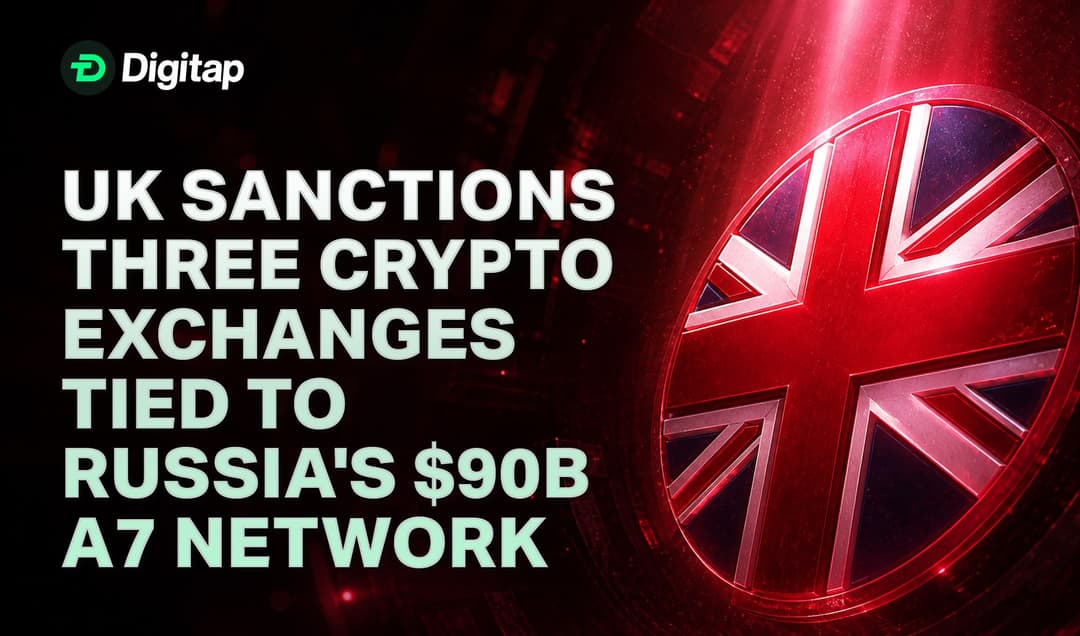
The UK Foreign Office added 38 names to its Russia sanctions list on Thursday, including three crypto exchanges, two payment platforms, and one company director, alongside two oil producers and a dozen shadow-fleet tankers. The government said the platforms helped Russia route money around Western restrictions, with two processing transactions for A7, a Kremlin-backed finance network the UK says has claimed to move more than $90 billion, roughly half of Russia’s annual military spending. It is the latest in a run of UK crypto designations that began with the exchange Grinex in August 2025 and reached Huobi Global, the parent of HTX, in May this year.Who Was Named, and Where They Sit
Cryptomus and Heleket are listed as a single entity: Xeltox Enterprises Ltd, a Vancouver-registered company that the UK says owns Cryptomus and carried on the same activity through Heleket. The sanctions notice also records Certa Payments as the firm’s former name. TokenSpot CJSC is a crypto exchange in Bishkek, Kyrgyzstan. Tsunami Payments LLC, one of the two payment platforms, is registered in the same office tower on Toktogul Street. The other payment platform is OJSC Processing KG, operator of the VexPay service. The UK’s listing names its parent as the Kyrgyz Ministry of Finance, and separately designates its director, Ulan Bukabaev, with an asset freeze and a travel ban. Every company on the list received the same measures: an asset freeze, a ban on UK banks processing its payments, director disqualification, and a sanction on UK internet services.Cryptomus Was Already Carrying a C$177 Million Canadian Fine
For Cryptomus, the UK designation lands a year after Canada’s financial intelligence agency penalised the same company. FINTRAC fined Xeltox C$176.96 million in October 2025, finding it failed to file suspicious transaction reports on 1,068 occasions in a single month and failed to report 1,518 large virtual currency transactions. The agency said the unreported activity included fraud, ransomware payments and sanctions evasion. Blockchain analytics firm Chainalysis, which published its own breakdown of the designations, says the two services received funds from more than 15,000 illicit actors, with activity surging to more than 900 in a single month in late 2025. Across the categories it tracks, including scams, sanctioned jurisdictions, and terrorist financing, the firm says Cryptomus and Heleket took in more money from illicit actors than all the mixing services it monitors combined.
How A7 and Its Ruble Stablecoin Fit In
A7 is the network behind A7A5, a stablecoin pegged to the Russian ruble that the UK says was designed to evade Western sanctions. The UK first targeted the network in August 2025, when it sanctioned Grinex and said the token had moved billions of dollars within months of launch. Thursday’s statement says A7 itself has claimed to move more than $90 billion. Chainalysis traced funds from TokenSpot, Grinex and a third exchange, Meer, converging on a single deposit address at HTX that received more than $308 million. Russia is building official digital money rails at the same moment: the state paid its first wages in the digital ruble this month. A7A5 is the unofficial version of that project, a ruble token that lives outside any banking system the West can reach.What a Sanctions Designation Actually Does to a Crypto Platform
A designation isn’t a court case, and the platform doesn’t need a UK office for it to bite. Three things happen at once. Any money the company holds with a UK bank or payment firm is frozen. UK financial institutions are barred from sending or receiving payments for it. Under the internet services measure, app stores, social networks, and internet providers must take reasonable steps to stop UK users from reaching its sites and apps. For an ordinary user, that means an app can vanish from the store, a card top-up can be refused and a transfer from a crypto wallet to the platform can be blocked by the sending bank. Dealing with a designated company from the UK can itself be an offence, which is why anyone weighing up the best crypto exchange for British use tends to check whether it screens deposits against the sanctions list.Could the Next Round Follow the Money Into Larger Exchanges?
The Kyrgyz thread runs through every recent UK crypto action. Capital Bank of Central Asia and Grinex were named in August 2025, and four of Thursday’s six crypto-related targets are Kyrgyz: three Bishkek companies and the director of one of them. If enforcement keeps following the money, the obvious next question is what happens to the venues receiving it. Chainalysis’s report already points to HTX, whose parent, Huobi Global, the UK designated in May 2026. HTX has disputed that designation, arguing it applies only to Huobi Global as a separate entity. Whether the measures hold could depend on whether the platforms simply rebrand, as analysts say happened when Grinex emerged after Garantex was shut down. The UK’s choice to list Cryptomus and Heleket as one entity, and to record Certa Payments as a former name, suggests officials are now writing designations with that rebranding playbook in mind.Sanctions Enforcement Is Moving From Coins to Payment Rails
The deeper shift is the target’s shape. Earlier rounds went after exchanges where ruble-linked tokens traded. This one adds merchant payment processors, including one whose listed parent is a government finance ministry, and reaches for the internet services measure so the block applies at the app store as well as the bank. For readers following the latest crypto news, the lesson from this week is that the sanctions perimeter around crypto is no longer drawn only around exchanges. It now runs through the gateways between a token and a real-world purchase, and the UK has shown it will name the plumbing, the people who run it, and the state bodies behind them.
Share Article

Madiha Riaz
Madiha is a seasoned researcher in cryptocurrency, blockchain, and emerging Web3 technologies. With a background in organic chemistry and a sharp analytical mindset, she brings scientific depth to decentralized innovation. Since discovering crypto in 2017 and investing in 2018, she’s been uncovering and sharing deep insights into how blockchain is redefining the digital asset landscape.