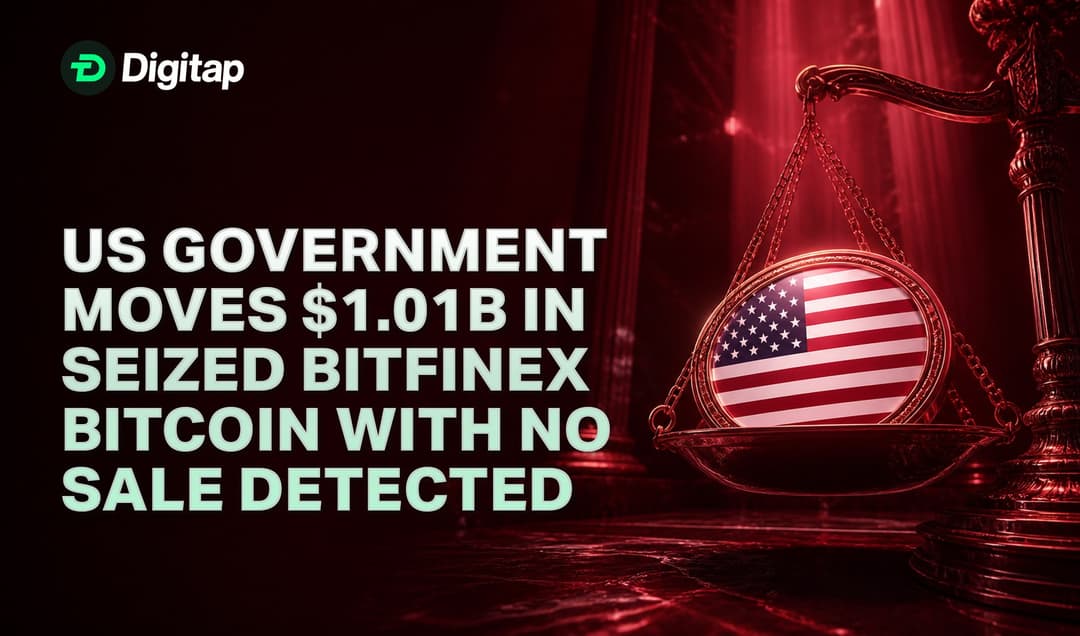
US Government Moves $1.01B in Seized Bitfinex Bitcoin With No Sale Detected
October 9, 2026
A Billion-Dollar Transfer Lands in a Nervous Market
A US government-controlled wallet moved 12,267 BTC, worth roughly $1.01 billion, on Thursday morning. The coins came from the stash seized after the 2016 Bitfinex hack, and the transfer landed in a market already on edge after a week of ETF outflows and a slide in the BTC price toward three-week lows. Nothing on the blockchain shows the coins reaching an exchange, and that detail matters: a sale of this size would rank among the largest sources of selling pressure the market has faced this year.What Moved, and Where It Went
According to blockchain analytics firm Arkham, as reported by CoinDesk, the transfer left the Bitfinex seizure wallet at 9:33 a.m. Eastern time on Oct. 8. A tiny 0.0012 BTC fragment went to a second wallet. Arkham later marked both outputs as spent, meaning the coins moved again, but no deposit to a known exchange wallet was recorded. The move followed a separate batch of activity on Wednesday. CoinDesk reported that government-linked wallets sent about 3,200 BTC, worth roughly $264 million, along with $119 million in USDT, to Coinbase Prime deposit addresses. Those funds traced back to wallets tied to the FTX and Alameda seizures as well as the Bitfinex case.How Blockchain Sleuths Track Government Money
Bitcoin’s ledger is public, so anyone can see every transfer. Analytics firms such as Arkham compare transaction patterns with known events, including court filings describing a seizure, and label the addresses involved. Once a wallet is tagged as belonging to the US Marshals Service or the Department of Justice, every coin that leaves it is watched in real time. The catch is that a transfer is not the same as a sale. Governments move coins between wallets for custody changes, audits, legal proceedings and restitution. Even a deposit to Coinbase Prime does not settle the question, because the platform offers institutional custody as well as trading. Only a deposit followed by matching sell-side activity, or an official statement, confirms that coins were actually sold. That gap is where most of the speculation lives, and it is why a single transfer can jolt crypto market prices for a few hours before the picture clears.
The Bitfinex Hack Behind the Coins
The coins trace back to August 2016, when attackers drained 119,754 BTC from the Bitfinex exchange. In February 2022, federal agents arrested Ilya Lichtenstein and Heather Morgan and seized more than 94,000 BTC linked to the theft, then worth $3.6 billion; the Justice Department called it its largest financial seizure ever. Lichtenstein was later sentenced to five years in prison and Morgan to 18 months. In January 2025, prosecutors asked a federal court to approve returning 94,643 BTC to Bitfinex as restitution, with about 25,000 BTC left in more complex forfeiture proceedings. That process is still unwinding. On Oct. 6, a government wallet sent 264.863 BTC, worth about $22.9 million, to Coinbase Prime in a transfer widely read as part of the Bitfinex restitution. That history reframes Thursday’s move. If the 12,267 BTC are part of the same pipeline, they are headed back to the exchange rather than to the open market, and they were never going to sit in a government reserve either.A Reserve That Says It Will Not Sell
The other reason traders paid attention is the Strategic Bitcoin Reserve. A March 2025 executive order directed that Bitcoin forfeited in criminal or civil proceedings be placed in the reserve, and the White House fact sheet stated that “the United States will not sell bitcoin deposited into this Strategic Bitcoin Reserve.” Treasury Secretary Scott Bessent reinforced that stance in August 2025, saying finally forfeited Bitcoin would form the reserve’s foundation and that Treasury would explore “budget-neutral pathways” to add more. Congress has also moved. A Bitcoin reserve bill cleared a House panel in September by a 28-21 vote, with language that would lock seized coins up for 20 years. Arkham’s tally, cited by Decrypt, puts total US government holdings at 306,795 BTC, worth roughly $25 billion at recent prices. Washington is one of the largest single holders of Bitcoin in the world, which explains why every outgoing transaction gets scrutinised.Why Government Wallets Can Move the Market
The market has seen what a real government sale looks like. In June and July 2024, German authorities sold roughly 49,858 BTC seized in a film piracy case, raising about $2.9 billion, according to The Block. The price slid as each tranche hit exchanges, and traders have treated large government transfers with suspicion ever since. Thursday’s move arrived at a sensitive moment. Cointelegraph reported more than $1.09 billion in liquidations over 24 hours as Bitcoin fell to $80,350, its lowest level since Sept. 18, before recovering to around $82,500 on Friday. In that environment, even a transfer with no sale attached adds to the uncertainty for anyone deciding whether to hold or buy crypto online.What Could Happen Next
Three paths are open. The coins could continue through the restitution pipeline and land with Bitfinex. They could be consolidated into custody arrangements connected to the reserve. Or, in the scenario the market fears, they could be sold, though the executive order’s no-sale language and the pending House bill make that path politically difficult for forfeited coins. Neither the Treasury Department nor the Justice Department had explained the transfer at the time of writing. Until one does, the wallet’s origin and the Oct. 6 restitution transfer point toward a return of funds rather than a sale, though that reading remains unconfirmed and could change if the coins surface on an exchange.Transparency Cuts Both Ways for a Bitcoin-Holding Government
Washington’s roughly $25 billion position is fully visible on-chain, which is unusual for a sovereign asset holding. Gold reserves are audited on paper. Bitcoin reserves are audited by anyone with a block explorer. That transparency gives the market early warning of any sale, but it also turns routine custody moves into headline events. Thursday’s transfer shows the gap between what the blockchain reveals (a movement) and what it cannot (the intent behind it). As the reserve takes shape and the Bitfinex restitution continues, the government’s on-chain footprint could become a recurring source of volatility, not because coins are being sold, but because nobody outside the government can say for certain that they are not.
Share Article

Madiha Riaz
Madiha is a seasoned researcher in cryptocurrency, blockchain, and emerging Web3 technologies. With a background in organic chemistry and a sharp analytical mindset, she brings scientific depth to decentralized innovation. Since discovering crypto in 2017 and investing in 2018, she’s been uncovering and sharing deep insights into how blockchain is redefining the digital asset landscape.