Social Recovery Wallets: The Future of Secure Seedless Access?
December 1, 2025
The Seed Phrase Problem
What is the single biggest fear of every crypto user? Losing their seed phrase. It is a simple string of twelve random words, yet it holds the keys to someone’s entire financial identity. If it is misplaced, stolen, or forgotten, access to all assets disappears permanently. There is no customer support line, no password reset, and no recovery option. The system is powerful, but it is also brutal.
This unforgiving design has done more harm to mainstream adoption than almost any other UX barrier. A 2024 global survey by Kraken found that 48% of crypto users fear losing access to their funds through personal mistakes, such as misplacing or incorrectly storing their seed phrase, making it one of the most anxiety-inducing aspects of self-custody.
The problem is simple. Seed phrases offer perfect mathematical security but terrible human usability. They require users to manage something fragile and easily lost, and they introduce a single point of catastrophic failure. For millions of people, this fear discourages them from exploring self-custody at all. With so much value stored in digital assets, relying on a slip of paper feels out of step with the advances in the rest of Web3.
This article introduces the concept of social recovery wallets, a security model that replaces the nerve-wracking seed phrase with a safer, more forgiving approach. You will learn what social recovery wallets are, how they function, and why they represent one of the most promising shifts toward making crypto safe, intuitive, and accessible for everyone.

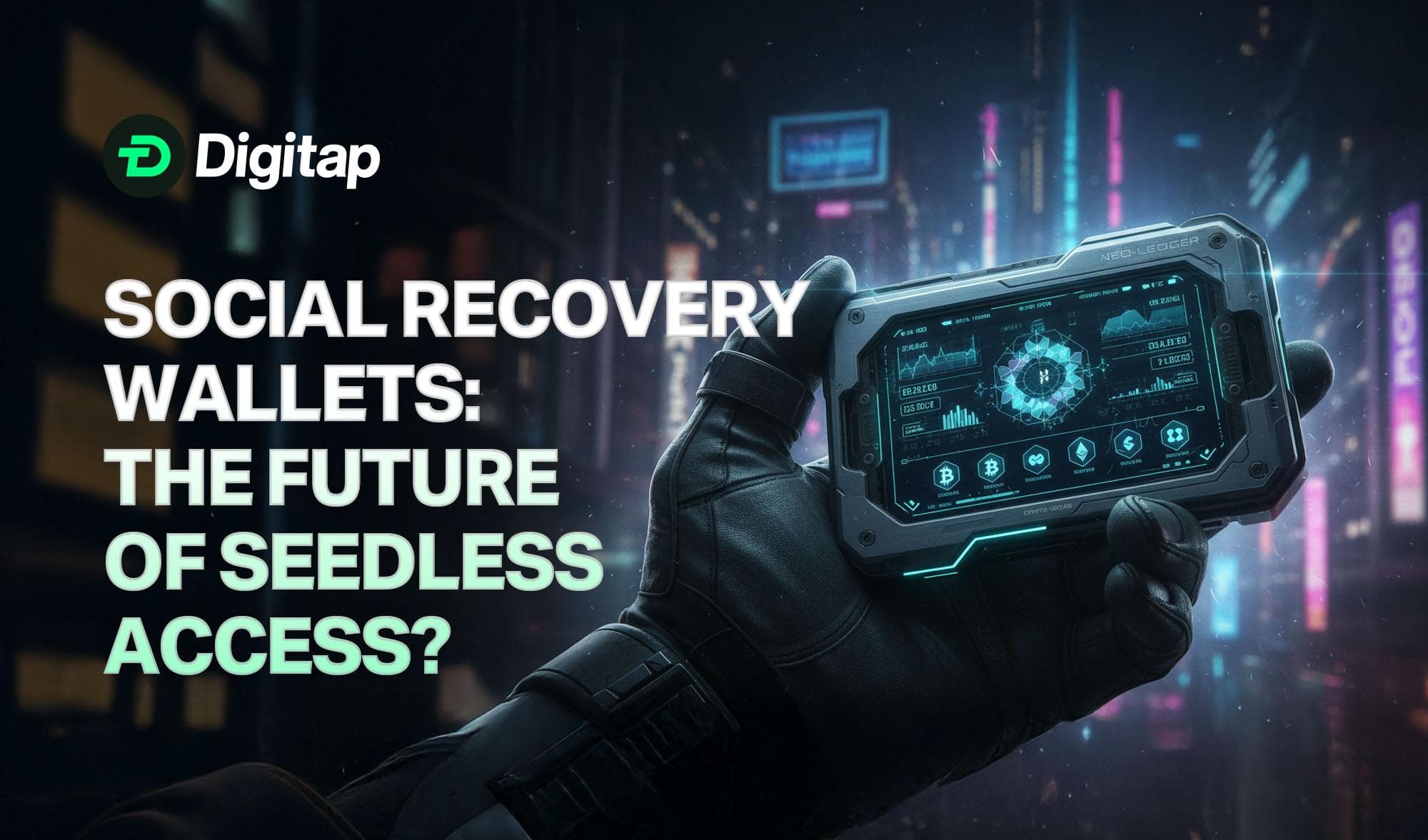
Future of Secure Seedless Access. Source: Helalabs
What Is a Social Recovery Wallet?
A social recovery wallet is a type of smart contract wallet that lets you regain access to your funds with the help of trusted people or devices instead of a seed phrase. Instead of relying on a single secret that you must store perfectly, your wallet security is shared across a small circle of trusted participants known as guardians.
This design moves away from the old model of “one seed phrase equals everything” and introduces a recovery process that feels much closer to the safety net people expect in modern digital systems. A social recovery wallet is still self-custodial. You remain in control of your assets at all times, but you gain an additional layer of protection that helps you recover access if your primary device is lost, stolen, or damaged.
The guardians you choose can be a mix of trusted friends, family members, your own devices, or specialized institutional services. In traditional settings, if you misplace access to your crypto wallet, everything is instantly at risk.
With social recovery, there is no single point where the system can fail, and you are not relying on a scrap of paper to protect your financial future. This is why many security researchers consider social recovery wallets to be one of the most meaningful innovations in Web3 security.

How Does It Work?
The recovery process for a social recovery wallet is designed to feel intuitive while still being highly secure. If you lose access to your primary device, such as your phone or laptop, you can begin a recovery flow directly through the wallet interface. The system then sends a recovery request to your guardians. Depending on the rules you defined earlier, a specific number of guardians must approve your request.
For example, if you chose five guardians, you might require that three of them approve before access can be restored. When the guardians confirm the recovery, the smart contract assigns wallet control back to you, allowing you to set a new primary device. The guardians do not gain access to your funds at any point. They only approve or deny the recovery attempt.
The technology behind this system is transparent because everything is managed through a smart contract on the blockchain. There is no customer support agent handling your request, and no centralized database storing your information. The rules are hard-coded, auditable, and executed exactly as designed. This gives users confidence that recovery cannot be tampered with, intercepted, or exploited by a single party.
A social recovery wallet works differently from a traditional seed-phrase-based crypto wallet, but the outcome remains the same because you still maintain full self-custody and complete control over your assets. The difference is that you gain a path back to your assets without relying on a single vulnerable piece of information.
The Benefits: Security, Usability, and Peace of Mind
The biggest advantage of social recovery wallets is that they eliminate the dreaded single point of failure. Users no longer need to remember or protect a fragile seed phrase. Instead, they secure their assets through a network of relationships and devices that make theft far more difficult and recovery far more achievable.
This change profoundly improves usability. Newcomers often feel overwhelmed by the idea that forgetting or misplacing a seed phrase could lead to losing everything. A recovery model that mirrors the familiar “forgot my password” flow in Web2 removes one of the biggest psychological barriers to self-custody. This allows people to focus on learning the ecosystem, exploring applications, or managing assets inside a digital wallet without the constant fear of making an irreversible mistake.
Social recovery also has important implications for inheritance. One of the most challenging questions in crypto is how to ensure your assets are passed on if something happens to you. Traditional seed phrases can be lost or mishandled in estate planning. With social recovery, wallet access can be regained through guardians and smart contracts, making it more compatible with real-world family and legal processes.
Security researchers consistently highlight that human error, not hacking, is the top cause of lost crypto funds. Several industry estimates suggest that between 2 and 4 million BTC may be inaccessible, which represents up to roughly 20% of the total supply. These estimates are based on analyses of long-dormant or abandoned wallets rather than confirmed reports of lost private keys.
While this number applies to Bitcoin and not Ethereum smart accounts, it illustrates the scale of the seed-phrase problem and why social recovery is such a meaningful step forward.
The Technology Behind the Magic: Account Abstraction (ERC-4337)
The rise of social recovery wallets has been enabled by a major innovation on Ethereum known as ERC-4337, commonly referred to as account abstraction. This upgrade brought smart-contract-based wallets into the mainstream without needing to change Ethereum’s underlying protocol. Instead, it introduced a new way for wallets to process transactions and define custom logic through user operations.
Account abstraction allows a wallet to behave more like a programmable smart account. Instead of being rigid and controlled solely by a private key, the wallet can include advanced features such as multi-signature authorization, session keys, and social recovery rules. This is the technological foundation that makes social recovery possible.
Thanks to ERC-4337, social recovery wallets can define rules like three out of five guardians must approve before recovery is granted. The entire process is handled by the smart contract. No centralized entity holds backup keys, no customer support agent intervenes, and no third party gains access to your funds. The rules are transparent, the logic is predictable, and the user remains fully sovereign.
Account abstraction has grown rapidly. According to the Ethereum Foundation and ecosystem dashboards tracking smart-account adoption, ERC-4337 wallets passed one million deployments by late 2024 as developers shifted toward safer, more flexible alternatives to seed-phrase-based systems.
This surge in adoption reflects a broader industry shift. Developers and security designers now recognize that the future of Web3 requires the best crypto wallet platforms that are both secure and usable. Account abstraction delivers those capabilities, and social recovery is one of its most impactful applications.
The End of the Seed Phrase Era
Social recovery wallets offer a more human, more intuitive, and more secure method for protecting digital assets. By replacing a single vulnerable seed phrase with a distributed network of guardians, they remove one of the most terrifying risks in self-custody. They also create a wallet experience that aligns with what ordinary people expect: a system that is secure but forgiving, powerful but easy to navigate.
These wallets still operate on decentralized smart contracts, meaning users retain complete ownership and control over their assets. They simply gain a safety net that reflects real human behavior. Instead of expecting every user to memorize a cryptographic secret, Web3 finally supports a model that embraces trust, relationships, devices, and transparent logic.
The impact is transformative. Instead of forcing newcomers to buy crypto just to set up a wallet or secure their seed phrase, the ecosystem can now onboard people with a smoother, safer foundation. In fact, as more teams integrate social recovery and other account-abstraction features, we are already seeing new wallet categories emerge.
As social recovery becomes the norm, the crypto industry can finally move beyond the fragile and unforgiving seed-phrase era and toward a future where self-custody is safe for everyone.
We are entering a time when losing your phone or switching devices will no longer threaten your financial life. People will connect, store value, manage assets, and explore Web3 with confidence, knowing that they can always recover their accounts through trusted guardians. This is the kind of foundation that allows crypto to grow from a niche technology into a global financial system.
Frequently Asked Questions
What is a social recovery wallet?
A social recovery wallet is a smart contract wallet that lets you restore access to your funds with the help of trusted guardians instead of relying on a traditional seed phrase. It spreads security across multiple participants, making it far more forgiving than single-key wallets.
Is a social recovery wallet safer than a regular wallet?
Yes. A social recovery wallet eliminates the single point of failure created by seed phrases. Even if your device is lost or compromised, you can recover access through your guardians. The guardians do not gain control of your funds; they only help approve recovery.
Who should I choose as my guardians?
Guardians can be trusted family members, close friends, secondary devices you own, or specialized institutional services. The best guardians are people or systems you trust and can easily reach.
What is account abstraction?
Account abstraction (ERC-4337) is a technology that allows wallets to behave like programmable smart accounts instead of traditional key-based accounts. This enables features like social recovery, custom authentication, session keys, and flexible transaction logic.
Which wallets support social recovery?
Several modern smart-contract wallets support social recovery, especially those built with ERC-4337 infrastructure. Options continue to expand as developers adopt account-abstraction-based designs and move away from seed-phrase-only systems.
Share Article

Madiha Riaz
Madiha is a seasoned researcher in cryptocurrency, blockchain, and emerging Web3 technologies. With a background in organic chemistry and a sharp analytical mindset, she brings scientific depth to decentralized innovation. Since discovering crypto in 2017 and investing in 2018, she’s been uncovering and sharing deep insights into how blockchain is redefining the digital asset landscape.