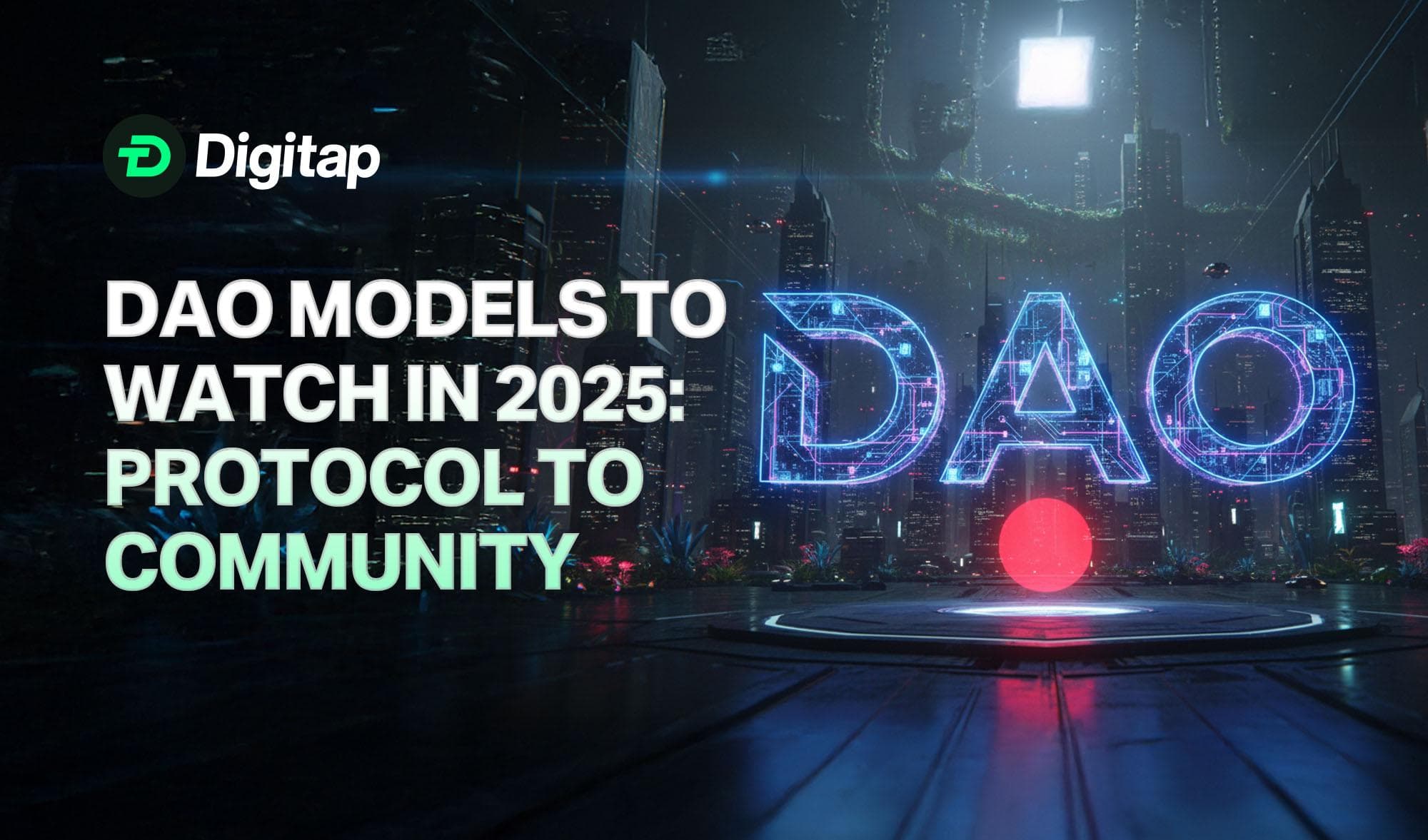
DAO Models to Watch in 2025: From Protocol DAOs to Community DAOs
November 30, 2025
The DAO is one of the most powerful and flexible new tools to emerge from the Web3 revolution. It is a new kind of organization, one that is owned and managed by its members. But what is a DAO, really? And what are the different forms that they can take?”
A DAO, or Decentralized Autonomous Organization, is an online community with a shared treasury (usually held in a smart contract or multisig digital wallet) and a built-in mechanism for members to vote on how to allocate funds. This structure allows participants to make decisions democratically and transparently, without relying on a centralized authority, giving the community full control over its resources and priorities.
Web3 is currently experiencing a ‘Cambrian explosion’ for DAOs: just as the Cambrian period saw a surge in biological diversity, 2025 is seeing an unprecedented variety of DAO models and experiments. According to Coinlaw, over 13,000 DAOs are now active worldwide in 2025. These organizations grew at an estimated compound annual growth rate (CAGR) of roughly 30% between 2021 and 2024.
No longer limited to a single structure or use case, DAOs now span a wide spectrum, from large, formal protocol-governing organizations to small, tight-knit community initiatives, each exploring new ways of decentralized collaboration.
This article will provide a guide to the different models of DAOs that are emerging in 2025. We will explore the spectrum from large, formal Protocol DAOs to small, informal Community DAOs, and we will highlight the key characteristics and use cases of each.
The DAO Spectrum
To make sense of its diversity, you may think of DAOs as existing on a spectrum. At one end, you have formal Protocol DAOs, which are massive organizations that govern multi-billion dollar platforms and make decisions that affect millions of users. At the other end, you have informal Community DAOs, which are basically tight-knit groups of people united by a shared passion or interest, often with just a few thousand dollars in the treasury.
Most DAOs fall somewhere in the middle of this spectrum. Some lean more toward the Protocol side, with formal governance processes and large treasuries. Others lean toward the Community side, emphasizing culture and collaboration over rigid structure. Many are actively trying to find the perfect balance between both ends.
It is important to understand where a DAO sits on this spectrum if one must assess its strengths and weaknesses. Why? Because it helps explain why some DAOs have highly formalized governance processes while others operate almost like clubs.
It also sheds light on why some DAOs attract hundreds of millions in capital, and others thrive with modest treasuries and tight-knit member bases.

Protocol DAOs: The Giants of DeFi
Protocol DAOs are the giants of the DAO ecosystem. These include well-known names such as MakerDAO, Uniswap, and others, which govern the largest decentralized finance (DeFi) platforms. They are responsible for managing billions of dollars in digital assets and making critical decisions about protocol upgrades, treasury management, and governance policies.

DAO protocol snapshot. Source: Snapshot
When most people hear the term “DAO,” they often think about Protocol DAOs without realizing it. These organizations dominate headlines, attract institutional attention, and set the standard for decentralized governance, serving as the backbone of the rapidly growing DeFi ecosystem.
The Structure
Governance in Protocol DAOs is typically formal, structured, and highly deliberate. Decision-making involves a rigorous process of proposals, discussions, and on-chain voting, with a strong emphasis on risk management and the sustainable growth of the protocol.
Many Protocol DAOs maintain dedicated governance committees, exclusive requirements, and multi-layered approval processes to ensure that major decisions are made thoughtfully and with community consensus.
Protocol-DAOs, on average, have about 72.5% of their treasury in native governance tokens and take up a substantial amount of the market share, with some DAO treasuries exceeding $1 billion. Mantle (formerly BitDAO) with $3.2 billion and Uniswap with $2.4 billion are two examples of such DAOs, according to data from DeepDAO.
These organizations make critical decisions about token distribution, protocol upgrades, treasury allocation, and risk parameters. Even a single misstep can have cascading effects across the entire ecosystem, affecting liquidity, user trust, and the broader DeFi market.
As such, for those interested in participating in these ecosystems, the first step is acquiring governance tokens, which are the key to voting and influencing protocol decisions. Platforms like Digitap offer secure, reliable ways to buy crypto and hold these tokens, providing both control and accessibility while integrating seamlessly with broader crypto and fiat management tools.
The Governance Model
Investors holding Protocol DAO’s token have the right to vote. Theoretically, this process is democratic as those with the most stake in the protocol have the most say in its future. Practically, however, governance power is often concentrated. A large percentage of voting power typically rests in the hands of a few large token holders (colloquially known as “whales”) and sometimes the core development team.
This concentration is actually a common challenge facing Protocol DAOs. Decentralization is the ideal, but in reality, token distribution often follows power-law patterns, with a small number of holders controlling a significant portion of voting power.
 Governance Token Concentration in Major DAOs: Source: DAOs Report, Chainalysis
According to data from Chainalysis, 1% of holders control 90% of voting rights in DAOs. This concentration means a small group could effectively overrule the majority, potentially discouraging smaller holders from participating in governance decisions.
Some Protocol DAOs have experimented with quadratic voting or delegation mechanisms to address this, but concentration remains a persistent issue.
Why Protocol DAOs Matter
Protocol DAOs represent the first large-scale experiment in decentralized governance, demonstrating that communities can coordinate effectively to manage complex systems. They have shown that governance tokens can function as a tool for decision-making, that decentralized communities can vote on protocol upgrades, treasury allocations, and risk parameters, and that DAOs can scale to manage billions of dollars in capital.
At the same time, Protocol DAOs have highlighted real-world challenges of decentralized governance. Issues such as voter apathy, governance gridlock, and the difficulty of maintaining true decentralization as protocols grow in size have emerged.
These lessons are invaluable for the next generation of DAOs, informing both technical development and community engagement strategies, and shaping the evolution of Web3 governance models.
Community DAOs: The Heart of Web3 Culture
If Protocol DAOs represent the industrial side of the DAO landscape, Community DAOs stand for its cultural and creative heart. These are DAOs, typically smaller in size, that form around a shared interest and identity.
The Diversity of Community DAOs
Community DAOs come in many shapes and serve a wide variety of purposes, showcasing the flexibility and inclusivity of the DAO model. These DAOs empower members to collaborate, pool resources, and make decisions collectively. Some common types include:
- Investment DAOs: Groups of friends, investors, or enthusiasts pooling funds to invest in NFTs, crypto projects, or startups. Members collectively decide which assets to acquire and manage risk together. Examples include BitDAO and Metacartel Ventures.
- Collector DAOs: Communities of artists, patrons, and fans who fund creative projects, curate art collections, or organize gallery shows both virtual and physical. Examples include PleasrDAO, known for acquiring high-value digital art, and FlamingoDAO, which invests in emerging artists and NFTs.
- Social DAOs: Clubs formed around ownership of specific NFTs or digital assets, giving members a platform to socialize, discuss projects, and coordinate community initiatives. Friends With Benefits (FWB), Bored Ape Yacht Club and Gitcoin DAO are popular examples in this category.
- Professional DAOs: Networks for individuals within a profession or industry, designed to share knowledge, coordinate projects, or collectively fund ventures, such as the MetaCartel Ventures DAO.
- Cause-Oriented DAOs: Communities that rally around environmental, social, or humanitarian causes, using pooled funds to drive impact and collective action. Prominent examples include ClimateDAO Klima DAO, and ConstitutionDAO.
- Experimental & Fun DAOs: Groups formed purely for experimentation, gaming, or social engagement, testing new governance structures or collaborative ideas. PleasrDAO and ApeCoin Dao are suitable examples for this category.
This variety highlights the adaptability of Community DAOs: they can facilitate financial collaboration, social engagement, cultural initiatives, or experimental governance. By providing transparent decision-making and collective ownership, they enable participants to actively shape the projects and communities they care about.
Governance and Culture
Governance in Community DAOs is often much more informal and social compared to their Protocol counterparts. While Protocol DAOs focus on risk management and protocol sustainability, Community DAOs are more about community building, collaboration/fun.
Voting might happen, but often major decisions are made through discussion and consensus-building. Many members of Community DAOs describe the experience as similar to being part of a close-knit club or friend group, but with the added benefit of shared financial resources and on-chain coordination.
Membership and Identity
Membership in Community DAOs is often represented by an NFT. Holding the NFT might grant you voting rights or access to exclusive channels.
The NFT-as-membership model has enabled entirely new forms of community organization. You can be a member of multiple Community DAOs, each with its own culture and purpose. Your membership is transparent on the blockchain, and you can transfer it if you decide to leave the community.
This design has helped build a thriving market for community membership NFTs and spawned thousands of experimental communities, many of which actively reward contributors through bounties and incentive programs.
Platforms like Digitap, with a secure crypto wallet solution, make it easy to securely hold and manage these NFT memberships, while also integrating with a broader crypto account for business, enabling seamless participation in both personal and professional DAO activities.
The Hybrid Models: Bringing Together the Best of Both Worlds
As the DAO landscape continues to mature, several organizations are now realizing that the Protocol DAO and Community DAO models each have distinct advantages (and distinct limitations). The latest innovation in DAO design is on hybrid models, which combine the best of both approaches.
Multi-DAO Ecosystems
Multi-DAO ecosystems are a feature of one approach. A large Protocol DAO, for example, might spin up several separate DAOs with different governance structures and purposes. A Protocol DAO might create a Grants DAO to fund community projects and builders.
It might create a Treasury Management DAO to oversee capital allocation, or even establish Social DAOs where token holders can gather and discuss ideas in a more informal setting.
This modular approach allows Protocol DAOs to maintain rigorous governance for core protocol decisions, creating space for the community culture and experimentation that Community DAOs excel at.
Governance Innovation in Community DAOs
Meanwhile, some larger Community DAOs have adopted more formal governance structures inspired by Protocol DAOs. They implement voting thresholds, deliberation periods, etc., not because they want to become like Protocol DAOs, but because they have found that as treasuries grow, some formality helps prevent poor decisions and backstabbing.
Finding the Middle Ground
The most successful hybrid DAOs appear to be those that opt strategically for formality. They maintain informal culture and casual decision-making for most day-to-day matters, but introduce formal governance processes for decisions that involve significant capital or underscore major strategic shifts.
This allows them to maintain a community feel and protect against catastrophic mistakes. What makes these hybrid models particularly attractive to members is the flexibility to choose how they join in; it could be by casual community building or active governance involvement.
Conclusion
DAOs exist on a spectrum, from the large and formal Protocol DAOs that govern DeFi giants to the small and informal Community DAOs that nurture Web3 culture and experimentation. Both ends of the spectrum serve important functions.
The DAO is a powerful new fundamental structure for human organization and collaboration. It allows users to coordinate resources and make decisions together. The incredible diversity of DAO models that we are seeing in 2025 is a sign of a healthy and innovative ecosystem, finding new applications for decentralized governance every day.
The future of work and community is being written right now in these new, decentralized entities. Want to join the revolution in decentralized governance? Use Digitap now to explore the world of DAOs, find a community that aligns with your interests, and get involved in shaping the future of Web3.
FAQs (Frequently Asked Questions)
What is a DAO?
A DAO is an online community with a shared digital treasury and a governance structure. It operates on the blockchain and, through smart contracts, automates decision-making and fund distribution.
What is the difference between a Protocol DAO and a Community DAO?
Protocol DAOs govern large Decentralized Finance (DeFi) protocols and manage billions in assets. Community DAOs prioritize community building over formal structure and are usually smaller and more culturally driven.
How do I join a DAO?
To join a DAO, you typically need to hold the relevant governance token or membership NFT. Most DAOs have Discord or Telegram communities where you can learn about the group, then afterwards may purchase the necessary token or NFT and follow the DAO’s onboarding process.
What is a governance token?
A governance token is a cryptocurrency token that grants its holder voting rights in a DAO. The number of tokens you hold typically determines your voting power. Many governance tokens also have other uses, such as fee discounts or revenue sharing.
Are DAOs the future of work?
DAOs stand as the new model for work and community. While its unlikely that they replace all traditional employment structures, they offer compelling alternatives for certain types of work, particularly in tech and creative fields. The future likely includes a mix of traditional employment/freelancing and DAO-based work.
Share Article

Tobi Opeyemi Amure
Tobi Opeyemi Amure is a full-time freelancer who loves writing about finance, from crypto to personal finance. His work has been featured in places like Watcher Guru, Investopedia, GOBankingRates, FinanceFeeds and other widely-followed sites. He also runs his own personal finance site, tobiamure.com