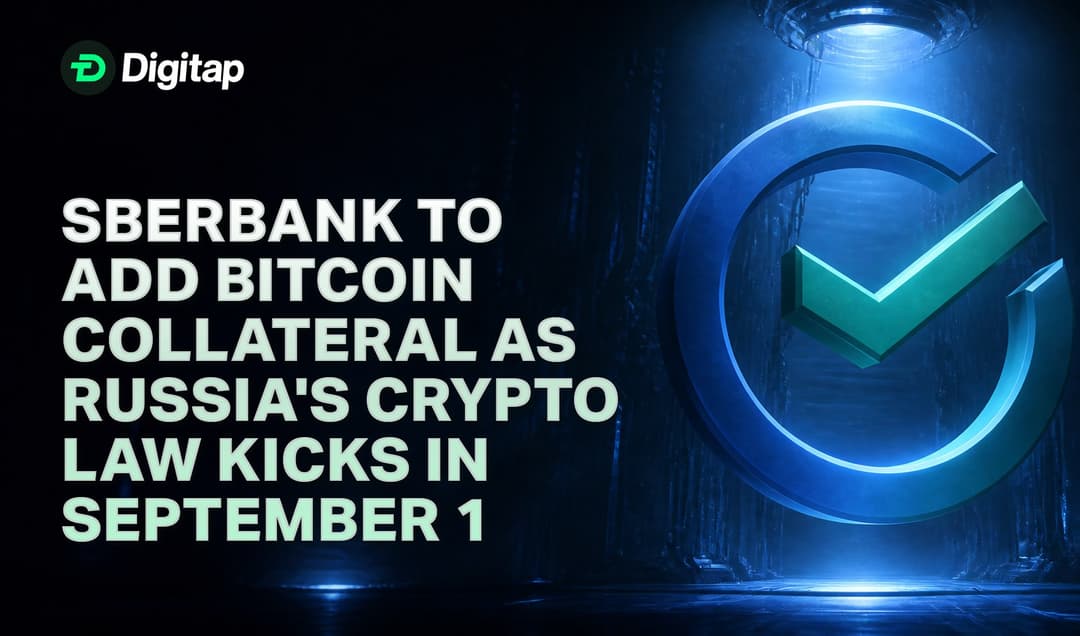
Sberbank to Add Bitcoin Collateral as Russia's Crypto Law Kicks In September 1
September 1, 2026
Sberbank Moves Bitcoin From Pilot Into Mainstream Corporate Lending
Sberbank, Russia’s largest bank, plans to accept Bitcoin as collateral for corporate loans as soon as the country’s new digital asset framework takes effect on September 1, according to CoinDesk. Deputy chairman Anatoly Popov said the bank intends to widen the product beyond BTC. “We plan to accept not only Bitcoin but also Ethereum and the stablecoin Tether as collateral,” Popov said, per crypto.news. The timing is unusually clean. Russia’s new framework goes live the same day, and Sberbank is stepping in the moment the legal door opens. A state-linked bank leaning into an asset class the Kremlin has treated warily for a decade is the news underneath the news.Russia’s New Digital Asset Framework Went Live Today
The framework that unlocks all of this took effect on Monday, placing digital assets under formal Bank of Russia supervision for the first time. It allows regulated intermediaries to offer trading, custody and lending services in a defined list of cryptocurrencies. Bitcoin is on that list. Ether and Tether’s USDT sit in a draft list the central bank is still finalising, which is why Sberbank’s ETH and USDT collateral plans are conditional rather than immediate. The framework also carries a compliance runway. Market participants have until July 1, 2027, to obtain the licences the new regime requires, giving banks, exchanges and custodians ten months to build the supervisory plumbing before enforcement tightens.How Crypto-Backed Loans Actually Work
A crypto-backed loan is a secured loan with crypto as the pledge. The borrower posts BTC or another approved asset, the bank lends cash against it, and the bank can sell the collateral if the loan is not repaid. The wrinkle with crypto is price movement. Bitcoin can swing 10% in a day, so lenders set a loan-to-value ratio well below 100%, often lending $50 against $100 of pledged BTC to build in a buffer. If the collateral drops below a set threshold, the bank issues a margin call and asks the borrower to post more. If the borrower cannot, the pledged crypto is sold. Custody, real-time price monitoring and clear default rules are the three parts every crypto lender has to solve.
From One Miner in December to a Broader Corporate Product
Sberbank has been running the machinery quietly for months. In December 2025 it issued what it described as Russia’s first Bitcoin-backed corporate loan to Intelion Data, a domestic mining operator that pledged mined BTC as security. That pilot was the point of the exercise. It let the bank stress-test custody, ongoing collateral-value monitoring and the enforcement steps that apply if a borrower defaults, all in a controlled setting with a single counterparty whose business already involved holding crypto. The bank has since said it wants to extend the product beyond miners to any corporate holding cryptocurrency on its balance sheet. Sberbank is targeting December 1 for the launch of a full digital-asset depository, the internal custody rail that lets the wider product scale.Ether and USDT Wait on the Central Bank’s Approval List
The BTC piece can move now because Bitcoin is already on the Bank of Russia’s list of assets approved for public circulation. Ether and USDT are not, yet. Popov was explicit that Sberbank will only add ETH and USDT collateral “after the Central Bank, of course, allows them for public circulation.” The draft list published by the central bank includes both, but the final version and the licensing conditions for intermediaries have not been signed off. USDT is the more consequential of the two for cross-border corporate lending, because a dollar-pegged stablecoin does not carry the price-swing overhead that Bitcoin or Ether does. A borrower can post $10 million of USDT and the bank knows exactly what it is holding. That predictability is why treasurers and CFOs typically prefer stablecoin collateral where the option exists, and why demand for a buy eth or USDT service tends to concentrate around institutional users first.Non-Qualified Investors Capped at 300,000 Rubles a Year
The retail side of the framework is tighter. Non-qualified investors can buy up to 300,000 rubles, roughly $3,300, in eligible cryptocurrencies each year through any single intermediary, a cap designed to limit household exposure while the regime beds in. That figure will feel restrictive to anyone who followed the parallel Vietnam framework that hit yesterday, which took a stricter enforcement approach with fines rather than allowances. The two frameworks activating within 24 hours of each other point to the same trend from opposite directions, with governments choosing to license and cap crypto activity rather than ignore or ban it. Institutional buyers face no equivalent ruble cap, which is why the corporate lending product Sberbank is building will move first while retail exchanges are still calibrating their onboarding flows.A State Bank Embracing Assets the State Once Rejected
A Kremlin-adjacent lender is publicly building infrastructure for assets Russian officials spent years calling speculative or destabilising. Sanctions changed the calculus. Settlement rails outside the dollar system became strategic, and stablecoins sit close to that need. Popov signalled where the bank is heading next, saying Sberbank plans to introduce international digital-currency settlement through its SberBusiness application by the end of 2026. That turns crypto collateral from a domestic lending product into a cross-border rail, which is the part regulators outside Russia will watch closely. Whether the bitcoin price responds this week is almost beside the point. The signal from Moscow on September 1 is that a G20 economy’s largest bank is now a licensed crypto lender, and that gives other state-linked banks in similar positions a precedent to point to.
Share Article

Madiha Riaz
Madiha is a seasoned researcher in cryptocurrency, blockchain, and emerging Web3 technologies. With a background in organic chemistry and a sharp analytical mindset, she brings scientific depth to decentralized innovation. Since discovering crypto in 2017 and investing in 2018, she’s been uncovering and sharing deep insights into how blockchain is redefining the digital asset landscape.