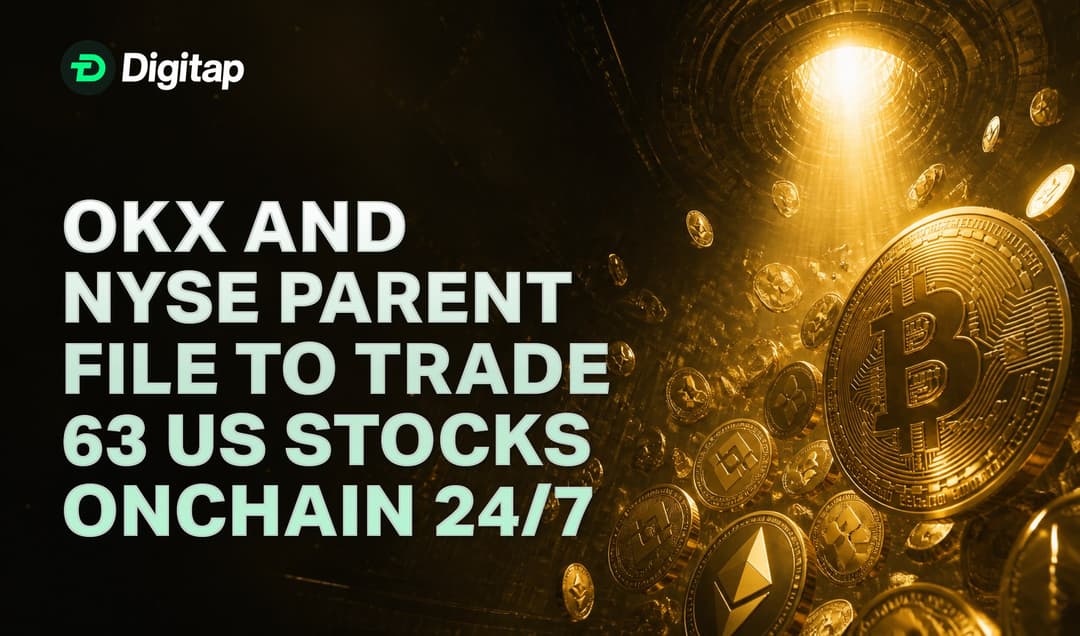
OKX and NYSE Parent File to Trade 63 US Stocks Onchain 24/7
October 5, 2026
The Owner of the NYSE Just Filed to Put Stocks on a Blockchain
The company that owns the New York Stock Exchange has told US regulators it intends to trade tokenized shares onchain, around the clock. OKXICE LLC, a joint venture equally owned by crypto exchange OKX and NYSE parent Intercontinental Exchange, notified the SEC on Monday that it plans to operate a tokenized securities venue. This is a notable line-crossing. Tokenized versions of Apple or Nvidia shares have existed for years, but almost always offshore and almost always closed to American investors. This filing aims the idea squarely at the US market, with the owner of the country’s largest stock exchange behind it.What OKXICE Filed, and What It Covers
A public notice dated 4 October lists 63 proposed stock symbols. The list includes mainstream technology and consumer giants such as Nvidia, Apple, Microsoft, and Tesla, alongside crypto-linked companies like Strategy, Coinbase, Circle, and Bitgo. The venue would run 24 hours a day, seven days a week, with settlement described as near-instantaneous rather than the next-business-day cycle US equities run on today. Holders would keep the economic and governance rights attached to the underlying share, meaning dividends and voting are preserved rather than stripped out. Star Xu, OKX’s founder and chief executive, framed the pitch around ownership rather than speed. “The future of markets is real ownership, onchain,” he said. “Full shareholder rights are what make that possible.”
What a Tokenized Stock Actually Is
Here is the mechanism in plain terms. A tokenized stock is a blockchain record that represents a real share held somewhere in the traditional system. Buying the token gives exposure to that share, and under this model the dividend and the vote travel with it. The practical difference is the plumbing underneath. Conventional share trading closes when the exchange closes, and ownership transfers a day later, as clearing houses and custodians pass records between each other. An onchain version settles on the ledger itself, so the trade and the transfer of ownership happen closer together, and the market has no closing bell. Crypto markets already work this way. Choosing the best crypto exchange never involves checking opening hours, because trading runs continuously and transfers confirm in minutes rather than overnight.The SEC Exemption That Made This Filing Possible
None of this would have been filed a month ago. On 17 September, the SEC issued what it calls an innovation exemption, a conditional five-year order that lets certain venues trade tokenized versions of US-listed stocks without registering as a national securities exchange. The order permits “permissioned trading via innovative automated market makers and liquidity pools”, in Commissioner Mark Uyeda’s words, using the same mechanisms that move most onchain crypto volume. Conditions come attached: the operator must be a US person subject to sanctions compliance, transaction price, size and time data must be published at regular intervals, and symbol limits and volume caps apply. The regulator’s stated reasoning was that the existing structure cannot deliver investor-facing benefits, including self-custody, fractional ownership, continuous trading, and faster settlement. It follows the same direction as the SEC’s other recent crypto work, which last week also proposed letting investment advisers hold client crypto themselves.Issuers Get 30 Days to Say No
The exemption contains a safeguard that could reshape the launch list. Any company whose shares are proposed for tokenization by an unaffiliated third party has 30 days from receiving notice to object. That gives 63 corporate legal departments a decision to make, and the final roster could be shorter than the filing suggests. Launch timing depends on that window closing and on further regulatory steps, so no start date is confirmed.A $3.2 Billion Market Looking for a US Front Door
The tokenized equities market is still small. It sits at roughly $3.2 billion, up around 15% over the past month, according to CoinDesk. For scale, that is a rounding error next to the daily turnover of the exchanges ICE already owns. OKX itself lists more than 70 tokenized stock tickers offshore, unavailable to US investors. ICE bought a stake in OKX in March at a $25 billion valuation, and the two set up the joint venture in June specifically to build infrastructure for tokenized products. Andrew Cuomo, the venture’s co-chair, treated the filing as a starting position. “Tokenization is gathering real momentum,” he told CoinDesk, adding that the opportunity now is to show “how 24/7, onchain markets can make trading and settlement more efficient, accessible and global”.Could Round-the-Clock Equities Pull Crypto Traders In?
If the venue launches, the effect on crypto markets may be indirect but real. Traders who already work weekends would gain equity exposure during hours when traditional brokers are closed, which could change how capital rotates between asset classes on a Saturday rather than waiting until Monday. Bitcoin was trading near $86,400 on Monday, still pressing at its 2026 yearly open around $87,570 as resistance. Nothing in this filing moves that level today, and crypto market watchers should expect any effect to arrive through flows over quarters, not candles over hours.When the Exchange and the Blockchain Stop Being Separate Places
The significance here is less about 63 tickers than about who is doing it. Until now, tokenized stocks have been an offshore workaround, built by crypto firms around the traditional system. This is the traditional system filing the paperwork itself, under a regulator’s exemption, with shareholder rights intact. Five years is a short leash, and a temporary exemption is a test, not a settlement. But if continuous onchain equity trading proves orderly inside that window, the distinction between a stock exchange and a blockchain venue starts to look like a technical detail rather than a category difference.
Share Article