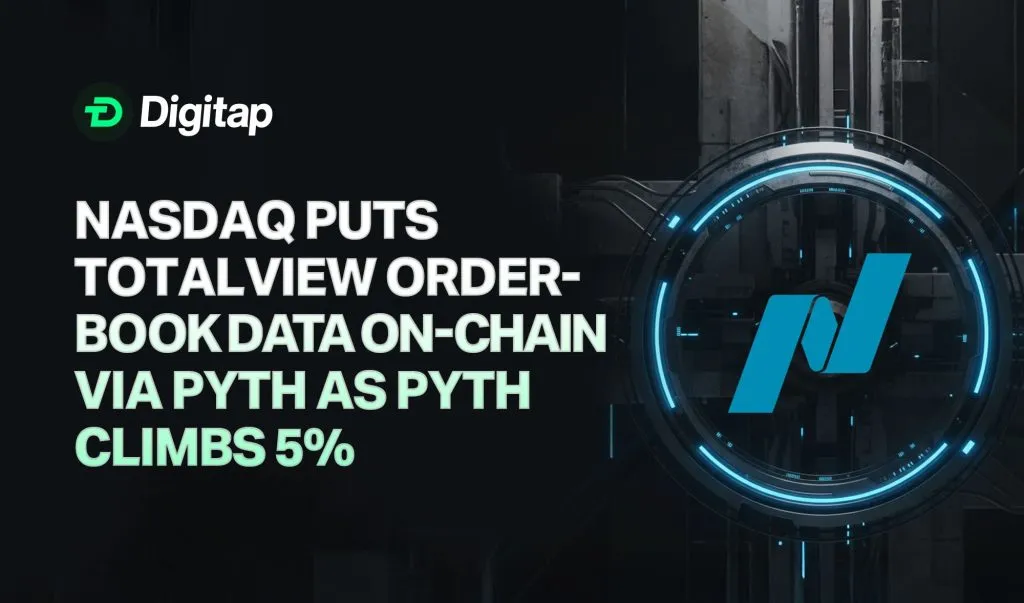
Nasdaq Puts TotalView Order-Book Data On-Chain via Pyth as PYTH Climbs 5%
July 4, 2026
Wall Street’s Order-Book Data Just Landed on a Blockchain
Nasdaq has started publishing its TotalView equities data directly on-chain through the Pyth Data Marketplace. The move, announced on June 30, 2026, is the first time the exchange’s full depth-of-book feed and its opening and closing order imbalance signals have been made available to blockchain applications. For years, decentralised protocols have leaned on scraped or delayed pricing to run everything from trading to lending. Getting live Nasdaq data at the source removes a friction that had kept serious institutional strategies off-chain. It also puts one of Wall Street’s most heavily consumed data products in front of a builder audience it has never really served before.Nasdaq Joins Pyth Network as a First-Party Publisher
Under the deal, Nasdaq becomes a first-party publisher on Pyth, streaming TotalView data straight into the network rather than routing it through a third party. Pyth’s oracle infrastructure then makes that feed accessible to smart contracts across more than fifty blockchains, according to Pyth Network’s announcement. TotalView is not the retail-facing summary quote often seen on brokerage apps. It is Nasdaq’s full order-book product, showing every displayed order at every price level, alongside opening and closing auction imbalance data. That is the same feed institutional trading desks use to size positions and time large orders.
PYTH Token Climbs on Institutional-Adoption Optimism
Markets responded quickly. The PYTH token traded higher after the news broke, climbing between four and six percent in the days that followed and extending gains further across the week, according to price data on CoinGecko. Volume on major venues thickened as traders repriced the network’s institutional footprint. The move stands out against a subdued backdrop for altcoins. Broader crypto market prices have been under pressure through late June, and a Nasdaq-branded catalyst is exactly the kind of story that cuts through low-liquidity summer trading. Analysts on X flagged the announcement as one of the more concrete Wall Street-to-Web3 links seen this year.How Blockchain Oracles Bring Real-World Prices to DeFi
For readers newer to the mechanics, an oracle is the piece of infrastructure that carries data from the outside world onto a blockchain. Smart contracts, the self-executing agreements that power decentralised applications, cannot fetch prices on their own. They need an oracle to feed them numbers they can trust. Pyth’s model uses first-party publishers, meaning the exchanges, market makers and trading firms that actually create the data push it directly to the network. That cuts out the middlemen who typically aggregate prices from public APIs. When a top-tier venue like Nasdaq joins that publisher set, the data quality bar rises across every application that reads from the network.Why TotalView Matters More Than Basic Price Feeds
Most on-chain price feeds today report a single spot price. TotalView layers in something richer: the depth behind that price, plus the imbalance data that professional traders use to anticipate opening and closing moves. That combination matters for anything that needs to model slippage, size collateral, or price complex derivatives on-chain. According to Cointelegraph, the deal marks the first time a major traditional exchange has committed its proprietary order-book product to a public blockchain infrastructure. That framing is echoed across the trade press, with CoinDesk noting the significance for tokenised equities and on-chain structured products.Could More Wall Street Data Providers Follow
The obvious question is whether other exchanges and vendors will follow suit. Nasdaq breaking cover could give competitors regulatory and commercial cover to do the same. CME, ICE and the major European venues each hold proprietary data products that would find a hungry audience in DeFi, and the pressure to reach on-chain users may only build as tokenised equities grow. Traders comparing the pricing they get on a top best crypto exchange versus a decentralised venue increasingly notice the gap. None of that is guaranteed. Traditional exchanges guard their data monetisation carefully, and public-blockchain distribution disrupts long-standing licensing models. Yet the direction of travel appears to be tilting toward openness, particularly as regulated tokenisation gains traction and requires reliable on-chain pricing. Access to that pricing may become a competitive necessity rather than a novel experiment.A Milestone in the Tightening Bond Between TradFi and DeFi
Whatever comes next, the Nasdaq-Pyth deal is a marker. It moves the conversation about traditional-finance integration past pilots and press releases into concrete data flowing on public rails. A retail investor opening a decentralised application from their digital wallet can now, in principle, look at the same order book a proprietary trading firm sees on its terminal. That does not solve every barrier between Wall Street and Web3. Regulation, custody and market structure remain live debates. But when the world’s second-largest stock exchange starts publishing its flagship data product straight onto a blockchain, the argument that these worlds are separate becomes harder to sustain. The plumbing is quietly being connected.
Share Article

Madiha Riaz
Madiha is a seasoned researcher in cryptocurrency, blockchain, and emerging Web3 technologies. With a background in organic chemistry and a sharp analytical mindset, she brings scientific depth to decentralized innovation. Since discovering crypto in 2017 and investing in 2018, she’s been uncovering and sharing deep insights into how blockchain is redefining the digital asset landscape.