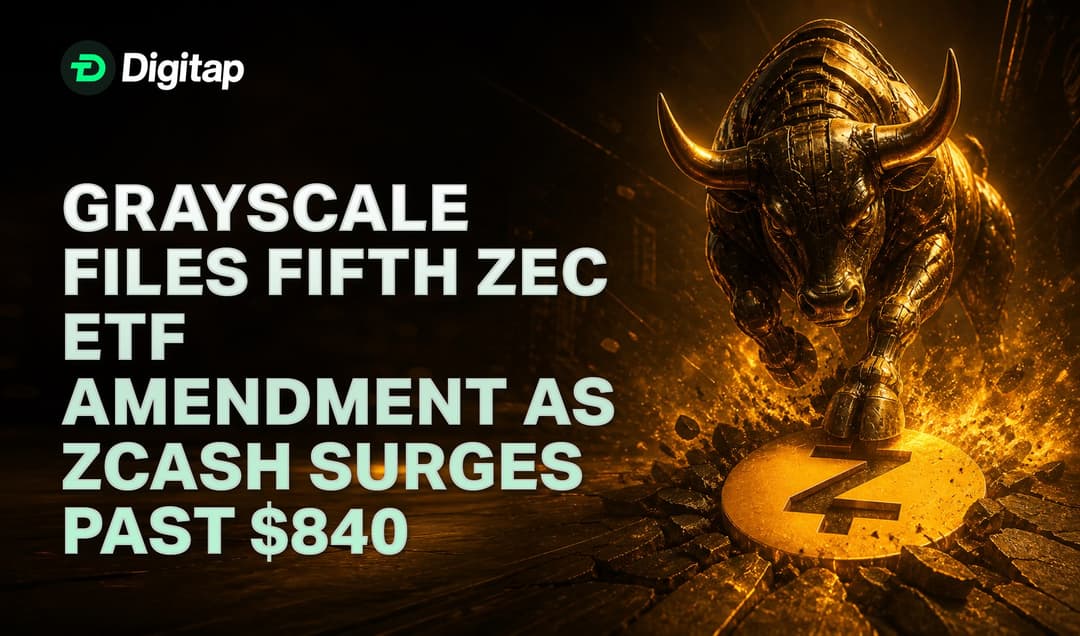
Grayscale Files Fifth ZEC ETF Amendment as Zcash Surges Past $840
August 25, 2026
Zcash Reaches Its Strongest Level of the Year
Zcash has become the standout performer of an already strong week for digital assets. The privacy-focused token traded near $841 on Sunday, according to CoinGecko data, after touching $848.65 during Saturday’s session. That is its highest level of 2026 and a price it had not held since November 2025.
The move did not come from nowhere. It followed a specific regulatory filing, and the size of the reaction says a good deal about how thin the supply of investable privacy assets has become.
Zcash now carries a market capitalisation of roughly $14.2 billion. Four days earlier that figure sat near $9.4 billion.
What Grayscale Filed on August 21
Grayscale submitted a fifth amendment to its registration statement for the Grayscale Zcash Trust on August 21, according to the trust’s filing history on the SEC’s EDGAR database. The document is an S-3/A, the amendment form used to update a registration statement already on file.
The filing moves the existing trust closer to becoming a spot exchange-traded fund. It proposes listing the shares on NYSE Arca under the ticker ZCSH.
This was the second amendment in three days. A fourth amendment landed on August 19, when ZEC was trading near $555.

A 200,000 Token Contribution Sits Inside the Paperwork
The more interesting detail is not the ticker. It is who may be putting tokens into the fund.
DCG International Investments, a subsidiary of Grayscale’s parent Digital Currency Group, is in discussions to contribute close to 200,000 ZEC to the vehicle, The Block reported in the earlier amendment. At the prices quoted when that was disclosed, the stake was worth about $110 million.
The filing carefully states that these are not binding agreements or commitments to purchase. Investors reading it should treat the contribution as a proposal rather than a completed transaction.
At Sunday’s price, the same quantity of tokens would be worth closer to $168 million. That gap is a neat illustration of how quickly the arithmetic changes underneath a filing that takes months to process.
How a Trust Turns Into an ETF
This part is worth slowing down on, because the difference matters and it is rarely explained.
A closed-end trust issues a fixed number of shares. If demand for those shares outpaces the tokens backing them, the shares can trade well above the value of the underlying assets. If demand falls away, they can trade well below it. Holders have historically had no reliable mechanism to close that gap.
An exchange-traded fund works differently. Authorised participants can create new shares by delivering the underlying asset, or redeem shares to take the asset back out. That two-way door lets professional traders arbitrage away most of the difference between the share price and the value of the fund’s holdings.
For an existing trust, conversion is therefore less about launching something new and more about repairing a structural flaw. It is the same reason several large crypto trusts have pursued the same route over the past two years.
Privacy Assets Return to Institutional Conversations
Privacy-focused tokens spent much of the last cycle out of favour, partly because exchanges in several jurisdictions delisted them under regulatory pressure. The current move suggests some of that caution has eased.
Analysts tracking the sector note that the pool of privacy assets with meaningful liquidity is small, which can amplify price moves when institutional interest appears. Multicoin Capital disclosed a significant ZEC position in May 2026, an early signal that professional allocators were revisiting the category.
None of this changes the underlying regulatory question. A privacy-preserving asset raises compliance considerations that a transparent ledger does not, and those considerations have not gone away simply because the price has risen. Anyone comparing options across a best crypto exchange listing will notice that availability still varies by region.
Will the SEC Sign Off, and When?
The honest answer is that nobody outside the process knows. An amended registration statement is a step in a sequence, not an approval, and the SEC has taken its time with novel asset classes before.
What can be said is that the path is now well travelled. The agency has approved spot vehicles for larger assets and recently advanced its first dedicated crypto fundraising framework, suggesting a broader willingness to write rules rather than decide on a case-by-case basis.
The market has already priced in a degree of optimism. That cuts both ways: if the timeline slips or the structure is questioned, the reaction could be sharp in the other direction. Investors watching this through a digital wallet or looking to buy crypto online should treat the current level as a bet on process, not a settled outcome.
A Test Case for What Gets Wrapped Next
The Zcash filing matters beyond Zcash. It is a reasonable test of how far the ETF wrapper now stretches.
The first wave covered the two largest assets, with the rationale being liquidity and investor demand. A second wave has reached further down the market, as the growing institutional appetite for XRP exposure showed earlier this month. A privacy coin is a harder case, because the objection is not size but the nature of the asset itself.
If a fund tracking a privacy-preserving token can clear the process, the practical limit on what can be packaged for a brokerage account will have moved again. That is the question sitting underneath a 40% week, and it will be answered on a regulatory calendar rather than a price chart.
Share Article

Madiha Riaz
Madiha is a seasoned researcher in cryptocurrency, blockchain, and emerging Web3 technologies. With a background in organic chemistry and a sharp analytical mindset, she brings scientific depth to decentralized innovation. Since discovering crypto in 2017 and investing in 2018, she’s been uncovering and sharing deep insights into how blockchain is redefining the digital asset landscape.